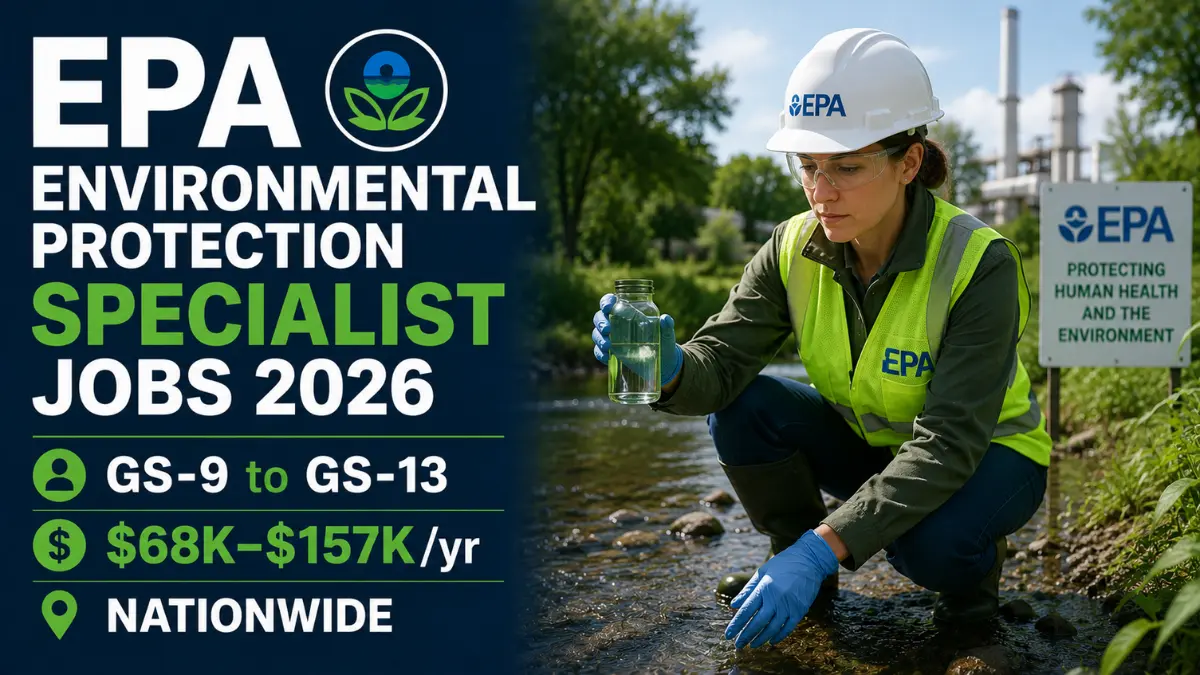
🟢 Status: ROLLING OPENINGS | Agency: U.S. Environmental Protection Agency (EPA) | Grade: GS-9 to GS-13 | Salary: $68,405–$157,323/yr | Location: Nationwide – 10 Regional Offices + HQ | Who May Apply: All U.S. Citizens
Every breath of clean air you take, every glass of tap water that meets safe standards, every contaminated Superfund site that gets cleaned up — these outcomes exist because of one federal agency and the specialists who power it. The U.S. Environmental Protection Agency (EPA) is America’s frontline defender of the natural environment, and the EPA Environmental Protection Specialist is the technical and regulatory professional at the center of that mission.
If you’ve been searching for EPA Environmental Protection Specialist jobs that combine hard science, federal law, and real-world environmental impact — 2026 is offering some of the strongest hiring momentum at EPA in years. Rolling USAJOBS postings at the GS-9 through GS-13 level are open across all ten EPA regional offices and multiple national program offices, covering everything from Superfund site remediation and Clean Air Act compliance to climate protection and water quality regulation.
Job Overview
| Field | Details |
|---|---|
| Agency | U.S. Environmental Protection Agency (EPA) |
| Job Title | Environmental Protection Specialist (Series 0028) |
| Announcement | Multiple – Rolling / Open Continuous |
| Grade & Pay Scale | GS-9 to GS-13 |
| Salary Range | $68,405 – $157,323/yr (locality-adjusted) |
| Location | EPA HQ (Washington, DC) + 10 Regional Offices nationwide |
| Open Date | Rolling – multiple announcements open simultaneously |
| Closing Date | Varies by announcement – apply immediately upon posting |
| Work Schedule | Full-Time; occasional travel required |
| Telework | Situational only – EPA requires regular in-office reporting |
| Who May Apply | All U.S. Citizens (public postings); some status-candidates only |
| Apply Now | Apply on USAJOBS |
What Does an EPA Environmental Protection Specialist Do?
The EPA Environmental Protection Specialist (OPM Series 0028) is the agency’s core technical generalist — a professional who applies knowledge of environmental law, science, and regulatory policy to protect human health and the natural environment. This is not a lab technician role. It is an analytical, regulatory, and policy-facing position that requires you to translate complex federal environmental statutes into enforceable action.
Depending on the EPA program office and region you’re assigned to, your daily work as an EPA Environmental Protection Specialist may look quite different. In the Office of Air and Radiation, you might be evaluating state implementation plans under the Clean Air Act (CAA). In the Office of Water, you could be reviewing National Pollutant Discharge Elimination System (NPDES) permits under the Clean Water Act (CWA). In the Superfund program, you may be coordinating remedial investigation and feasibility studies at contaminated hazardous waste sites under CERCLA — the Comprehensive Environmental Response, Compensation, and Liability Act.
This breadth is exactly what makes federal environmental science jobs in 2026 at EPA so compelling for candidates with science, engineering, law, or public policy backgrounds. No two days — and no two postings — are identical.
Why EPA Is Hiring in 2026
EPA jobs in 2026 are in high demand across multiple program offices for several converging reasons. An administration-level emphasis on climate resilience, water infrastructure investment through the Bipartisan Infrastructure Law, and a generational wave of EPA retirements have combined to push the agency into active hiring mode across its GS-9 through GS-13 career ladder.
For candidates asking how to become an EPA Environmental Protection Specialist in 2026, the timing is ideal. Program offices posting Environmental Protection Specialist vacancies in 2026 include the Office of Air and Radiation, Office of Water, Office of Land and Emergency Management (which houses the Superfund program), Office of Chemical Safety and Pollution Prevention, and all ten EPA regional offices. Rolling announcements mean new postings appear regularly — early action on each new posting is essential.
Salary & Benefits
| Benefit | Details |
|---|---|
| GS-9 Base Salary | $68,405 – $88,926/yr |
| GS-11 Base Salary | $83,854 – $109,011/yr |
| GS-12 Base Salary | $100,499 – $130,649/yr |
| GS-13 Base Salary | $119,554 – $157,323/yr |
| Locality Pay | Up to 33% additional — DC, NYC, SF, Boston, Chicago areas |
| Paid Annual Leave | 13–26 days/year (based on tenure) |
| Sick Leave | 13 days/year |
| Federal Holidays | 11 paid holidays |
| Health Insurance | FEHB — government pays ~72% of premium |
| Dental & Vision | FEDVIP |
| Retirement | FERS pension |
| TSP (401k) | Up to 5% government matching |
| Life Insurance | FEGLI |
| Paid Parental Leave | 12 weeks |
| Student Loan Repayment | Available for select EPA positions |
| Flexible Work | Workplace flexibility options available per EPA policy |
A GS-13 EPA Environmental Protection Specialist salary in the Washington DC locality area can reach $155,000–$165,000 per year with locality pay applied — placing these roles among the highest-paying mid-career federal environmental science jobs in 2026.
GS Grade Ladder: EPA GS-9 to GS-13
Understanding the EPA GS-9 to GS-13 career ladder is key to applying at the right level:
| Grade | Experience Required | Base Salary |
|---|---|---|
| GS-9 | 1 year specialized at GS-7 equivalent OR Master’s degree | $68,405–$88,926/yr |
| GS-11 | 1 year specialized at GS-9 equivalent OR Ph.D. | $83,854–$109,011/yr |
| GS-12 | 1 year specialized at GS-11 equivalent | $100,499–$130,649/yr |
| GS-13 | 1 year specialized at GS-12 equivalent | $119,554–$157,323/yr |
Many EPA announcements are structured as career-ladder positions from GS-9 to GS-12, meaning you can enter at the GS-9 level and be promoted annually based on performance — no competing for your own promotion until you reach GS-12. GS-13 roles are typically full-performance, non-ladder positions posted separately.
Qualifications & Requirements
These are the standard Environmental Protection Specialist qualifications and requirements for 2026 EPA public postings:
Education
- A bachelor’s degree in environmental science, environmental engineering, biology, chemistry, geology, physics, geoscience, public health, or a closely related natural science field is the standard minimum
- A Master’s degree in environmental science or a related field can substitute for one year of specialized experience (qualifying directly at GS-9)
- A Ph.D. or equivalent can substitute for specialized experience at the GS-11 level
- Degrees in environmental law, public policy, or economics are also accepted for policy-facing positions
- EPA explicitly recognizes that a broad undergraduate foundation across biology, chemistry, geology, and environmental policy is ideal for this role
Specialized Experience (by Grade)
GS-9: One year of specialized experience at GS-7 equivalent — such as reviewing environmental permits or grants for accuracy; assisting in monitoring or compliance activities related to environmental regulations; participating in environmental assessments or data analysis projects.
GS-11: One year at GS-9 equivalent — reviewing and processing grants, cooperative agreements, or interagency agreements; collaborating with state, local, or tribal governments on environmental compliance; analyzing environmental data and drafting technical reports for program leadership.
GS-12: One year at GS-11 equivalent — serving as a technical/programmatic specialist advising state/local/tribal governments on environmental program implementation; assisting project managers on ad hoc environmental remediation or compliance teams; reviewing grants and cooperative agreements for substantive technical accuracy under CERCLA, CWA, CAA, or related statutes.
GS-13: One year at GS-12 equivalent — leading complex, multi-stakeholder environmental projects; providing authoritative technical and policy guidance to senior EPA leadership; coordinating Superfund remedial actions or major regulatory compliance initiatives independently.
Key Technical Competencies EPA Assesses
- Knowledge of federal environmental statutes: CERCLA (Superfund), Clean Air Act (CAA), Clean Water Act (CWA), RCRA, TSCA, EPCRA, SARA
- Ability to apply analytical and evaluative methods to environmental regulatory questions
- Experience with environmental compliance monitoring, inspection, or enforcement support
- Written and oral communication skills — preparing technical memos, briefings, and regulatory documents
- Experience with grants/cooperative agreement management (for program office positions)
Other Requirements
- U.S. Citizenship required
- Background investigation required
- Drug testing may be required for specific positions
- Financial disclosure required for some senior positions
- Occasional travel (typically 10–25%) to field sites, state offices, or Superfund locations
Key Duties & Responsibilities
Depending on the EPA program office and grade level, an Environmental Protection Specialist may be responsible for:
- Reviewing and evaluating state implementation plans, permits, and compliance certifications under the Clean Air Act and Clean Water Act
- Providing technical assistance to state, tribal, and local governments implementing EPA-funded environmental programs
- Reviewing and managing grants and cooperative agreements for technical accuracy and regulatory compliance
- Coordinating remedial investigation and feasibility studies at Superfund / CERCLA contaminated sites, including working with potentially responsible parties (PRPs)
- Drafting policy options, technical guidance documents, and regulatory analysis memos for senior EPA leadership
- Conducting site inspections and compliance monitoring activities across EPA’s enforcement programs
- Analyzing environmental data — air quality measurements, water quality monitoring results, hazardous waste inventories — and preparing technical reports
- Briefing senior officials, congressional staff, and interagency partners on program status and environmental outcomes
- Supporting EPA’s climate protection and greenhouse gas emission reduction programs under the Office of Air and Radiation
- Coordinating environmental review activities under the National Environmental Policy Act (NEPA)
EPA’s Major Environmental Programs — Where Specialists Work
EPA Clean Air Act and Clean Water Act jobs span multiple offices and represent the core regulatory work of the agency. Here is where Environmental Protection Specialists are embedded across EPA’s structure:
| Program Office | Primary Statutes | Example Specialist Work |
|---|---|---|
| Office of Air & Radiation | Clean Air Act (CAA) | State implementation plan review, greenhouse gas standards, air quality modeling |
| Office of Water | Clean Water Act (CWA), Safe Drinking Water Act | NPDES permit review, water quality criteria, drinking water compliance |
| Office of Land & Emergency Management | CERCLA (Superfund), RCRA | Hazardous waste site remediation, emergency response coordination |
| Office of Chemical Safety | TSCA, EPCRA | Toxic substance risk assessment, pesticide regulation |
| Office of International Affairs | Multiple | Cross-border environmental compliance, international treaty support |
| Regional Offices (1–10) | All statutes | On-the-ground state/tribal assistance, compliance monitoring, grant oversight |
EPA Superfund and CERCLA specialist jobs are among the most technically demanding in the agency — requiring knowledge of hazardous substance liability, remedial action planning, and multi-party cost recovery — and they consistently offer some of the strongest career advancement opportunities within EPA’s structure.
How to Apply for EPA Environmental Protection Specialist Jobs
EPA regional office jobs on USAJOBS in 2026 follow the standard federal competitive hiring process with a few EPA-specific rules:
- Create or update your USAJOBS profile at usajobs.gov
- Build a strong federal resume — unlike private-sector resumes, federal resumes are detailed (4–6 pages typical). List every duty, accomplishment, hours per week, and supervisor for each position. Mirror language from the specific EPA announcement
- Search USAJOBS for “Environmental Protection Specialist EPA” — filter by agency (Environmental Protection Agency) and grade level. New postings appear on a rolling basis; set up a saved search with email alerts
- Read each announcement carefully — some are open to all U.S. citizens; others are status-candidate or EPA-internal only. Prioritize open-to-public postings
- Complete the online occupational questionnaire — EPA uses USA Hire assessments for many positions. Answer accurately based on your actual experience; inflated responses can trigger disqualification after a skills audit
- Attach required documents: federal resume, transcripts (education is heavily weighted for GS-9 and GS-11 entry), DD-214 if a veteran, SF-50 if a current/former federal employee
- Note EPA’s resume page limit — some EPA announcements explicitly state that resumes exceeding two pages will be removed from consideration. Read the specific announcement requirements carefully
- Prepare for a structured behavioral or panel interview — EPA uses competency-based interviews focused on technical environmental knowledge, analytical skills, stakeholder coordination, and written communication. Prepare STAR-method examples from your environmental work history
- Complete background investigation post-offer — typically a low-level public trust background check for most EPA positions
⚠️ Important: EPA’s rolling postings frequently close as soon as a sufficient applicant pool is reached — sometimes within 48–72 hours of opening. Apply the same day you discover an announcement. Set up a USAJOBS email alert for “Environmental Protection Specialist EPA” to catch new postings instantly. Apply directly at epa.gov/careers/epa-job-openings
EPA Regional Offices — Where These Jobs Are Located
EPA regional office jobs span all 10 EPA regions, covering every state and U.S. territory:
| Region | States Covered | Regional HQ |
|---|---|---|
| Region 1 | CT, MA, ME, NH, RI, VT | Boston, MA |
| Region 2 | NJ, NY, PR, USVI | New York City, NY |
| Region 3 | DC, DE, MD, PA, VA, WV | Philadelphia, PA |
| Region 4 | AL, FL, GA, KY, MS, NC, SC, TN | Atlanta, GA |
| Region 5 | IL, IN, MI, MN, OH, WI | Chicago, IL |
| Region 6 | AR, LA, NM, OK, TX | Dallas, TX |
| Region 7 | IA, KS, MO, NE | Lenexa, KS |
| Region 8 | CO, MT, ND, SD, UT, WY | Denver, CO |
| Region 9 | AZ, CA, HI, NV, Pacific Islands | San Francisco, CA |
| Region 10 | AK, ID, OR, WA | Seattle, WA |
| HQ | National Programs | Washington, DC |
Regional office positions often provide the most direct, hands-on environmental regulatory work — state assistance, compliance monitoring, Superfund site oversight — while national program office positions at HQ tend to focus more on policy development, national guidance, and regulatory drafting.
Veterans’ Preference
Veterans’ preference applies to competitive EPA hiring under standard federal rules. Five-point preference applies to veterans with qualifying active-duty service. Ten-point preference applies to veterans with a service-connected disability of 10% or more. Veterans with 30%+ compensable disability ratings may be appointed non-competitively via Schedule A. Veterans with military backgrounds in environmental health, civil engineering, hazardous materials handling, nuclear/CBRN operations, or environmental compliance have directly transferable experience for EPA Environmental Protection Specialist positions.
About the EPA
The U.S. Environmental Protection Agency (EPA) was established in 1970 under President Richard Nixon in response to growing public concern over air and water pollution. Today EPA employs approximately 14,000 federal workers and administers over a dozen major federal environmental laws — including the Clean Air Act, Clean Water Act, CERCLA (Superfund), the Resource Conservation and Recovery Act (RCRA), the Toxic Substances Control Act (TSCA), and the Safe Drinking Water Act.
EPA’s mission — “to protect human health and safeguard the environment: the air, water and land upon which life depends” — plays out through regulatory rulemaking, compliance enforcement, scientific research, grant administration to states and tribes, and international environmental cooperation. A career at EPA as an Environmental Protection Specialist means spending your working life at the intersection of science, law, and public service — protecting the environmental commons that every American depends on.
FederalJobsAlert.us is an independent job notification website. This listing is sourced from USAJOBS.gov for informational purposes only. Always verify the latest details and apply directly at usajobs.gov. We are not affiliated with the U.S. Environmental Protection Agency or any U.S. government agency.
Sources
- USAJOBS – EPA Environmental Protection Specialist Announcement
- EPA Job Openings – Official EPA Careers Page
- EPA About Salaries
- OPM GS-0028 Environmental Protection Specialist Qualification Standards
Other Federal Jobs
NASA Aerospace Engineer Jobs 2026 – Marshall Space Flight Center | GS-12 to GS-14 | Direct Hire → https://federaljobsalert.us/nasa-aerospace-engineer-jobs-2026-marshall-space-flight-center/
USDA Research Social Scientist Jobs 2026 – GS-12 to GS-15 | Kansas City, MO | USAJOBS → https://federaljobsalert.us/usda-research-social-scientist-jobs-2026/